
MECEE-PG MD/MS: What to Study First — and Why
Not every topic deserves equal attention. MEC subject weightage tells you where the marks are. Modern MECEE-PG previous-year question evidence shows where questions have appeared and where that evidence recurs across exam years. Your own performance shows where you are still vulnerable.
The useful question is not “What should I study?” It is “What should I study first?” Start with the official blueprint, narrow it with direct MECEE-PG/CEE evidence, then let your own weak areas decide the next study block.
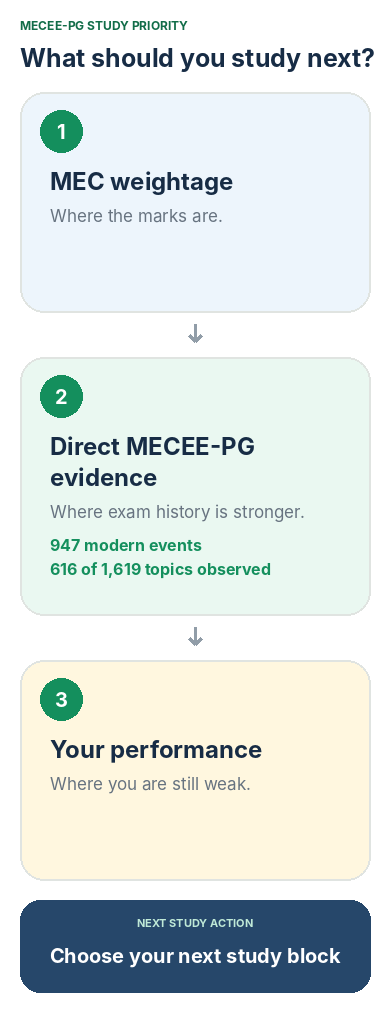
Start with the marks, then narrow with evidence
The Medical Education Commission (MEC) postgraduate syllabus does not distribute marks evenly. Medicine and Surgery carry 18 marks each, while Obstetrics & Gynaecology, Pediatrics, Anatomy and Physiology carry 12 marks each. That immediately makes some subjects more consequential than others.
But “revise Medicine” is still too broad to guide a study session. The next layer is topic-level exam evidence: which topics inside that subject have actually appeared in modern MECEE-PG/CEE history, and how often has that evidence recurred?
For the complete official subject distribution, see the MECEE-PG MD/MS syllabus and subject-weightage guide.
MEC weightage → direct MECEE-PG PYQ evidence → your performance → next study action
What the MECEE-PG PYQ signal actually means
A topic-level MECEE-PG PYQ signal is a prioritization signal built from governed historical PYQ evidence across multiple lenses, including how often and how repeatedly topics appear across exam years.
- More governed modern MECEE-PG/CEE events are mapped to it.
- Recurrence across different exam years strengthens the case.
- It deserves more attention when it also sits inside a high-weightage subject or a personal weak area.
- The exact question will repeat.
- The topic is guaranteed to appear next time.
- Topics with no modern PYQ evidence should be skipped.
That distinction matters. PYQ evidence is useful because it helps rank attention—not because it can predict the next exam.
See the evidence, not an opaque score
The most convincing way to use the signal is to show the underlying evidence. These examples use only modern MECEE-PG/CEE PYQ events and the number of distinct exam years in which those events appeared.
| Subject | Topic | Modern PYQ events | Distinct exam years |
|---|---|---|---|
| Surgery | Thoracic Trauma | 7 | 5 |
| PSM | Screening of Disease | 5 | 4 |
| Microbiology | Sterilization & Disinfection | 5 | 4 |
| OBGYN | Hormonal Contraception | 4 | 4 |
| Pathology | Cell Death | 4 | 3 |
| Medicine | Electrolyte Disorders | 4 | 3 |
Take Thoracic Trauma: 7 modern MECEE-PG/CEE events are spread across 5 distinct exam years, giving it a stronger historical reason to compete for revision time than a topic with no direct modern evidence.
Turn the evidence into a study decision
PYQ evidence becomes useful only when it changes what you do next. Combine it with the official blueprint and your own performance.
Direct MECEE-PG evidence is strong here, and you are still unstable. This is the clearest case for immediate revision.
Do not ignore it. The official syllabus still matters even when PYQ history is sparse.
Comfortable revision should not repeatedly displace higher-priority weaknesses.
This is the practical value of the signal: it replaces a vague “high-yield” label with a reason you can inspect.
Use PYQs as diagnostics, not answer keys
Choose the topic for a reason
Start with subject weightage, then narrow using direct MECEE-PG evidence and your own weak areas.
Attempt before reviewing
Use questions to test retrieval. Passive rereading mostly tells you what feels familiar.
Fix the reason you missed it
Separate knowledge gaps from recall failure, interpretation errors, option confusion and timing problems.
Retest with fresh mapped questions
The goal is to repair the concept, not memorize the answer to one old question.
How StudyDote turns this into a next action
StudyDote applies the same decision logic inside the product: it combines syllabus importance, MECEE-PG PYQ evidence, your recent performance and revision timing to choose a focused next task. That task can be learning a topic, solving mapped MCQs, reviewing mistakes or repairing a weak area.
The result is a more defensible next study block: which important topic needs attention now, and what should you do with it?
StudyDote’s broader Nepal PYQ signal can also incorporate older Nepal evidence, with modern evidence deliberately weighted more heavily. The model below separates the governed evidence corpus from the signal weighting.

Sources and freshness
Official subject structure is taken from Nepal's Medical Education Commission postgraduate syllabus. As checked on 5 Oct 2026, MEC's current syllabus directory still points to its postgraduate entrance syllabus (2020). Topic-level examples in this article use StudyDote's governed modern MECEE-PG/CEE evidence layer.
Modern evidence snapshot: 947 modern MECEE-PG/CEE PYQ events; 616 of 1,619 governed shared-medical topics with direct modern evidence.
Broader Nepal signal corpus: 947 modern + 1,518 legacy = 2,465 governed events; signal blend 60% modern + 40% legacy.
Method note: the governed evidence framework deduplicates historical PYQ events rather than treating provider copies as separate evidence. CPD evidence is governed separately. Reviewed 5 Oct 2026. Current-cycle eligibility, dates and other rules that can change should always be checked against the latest MEC notice.